I enjoyed this video of Los Angeles at night. A different way to see my market.
Monday, January 31, 2011
Twilight Landing At LAX (Cockpit View)


Thursday, January 27, 2011
Egyptian Riots & You
"The desire to protest has overwhelmed a large sector of society"
Egypt is going through the most significant political upheaval in over 34 years. The reasons are multi-faceted, but have to do with rising food prices and people feeling disenfranchised.
The same thing is happening in Tunisia and now Yemen.
Egypt is a bigger worry for me, the reason being that it controls (controlled?) the Suez Canal.
The Suez Canal is one big choke point for world trade and most importantly, oil. Along with the canal is the Sumed Pipeline, which crosses the northern region of Egypt.
Why is this important? Because nearly all the northbound oil shipments out of Saudi Arabia, 2.3 million barrels a day, goes through that pipeline.
Basically, if you are trying to ship oil out of the Middle East to Europe or the United States, you go through Egypt.
As events unfold, I will be watching the price of oil more closely, as it will greatly effects the profitability of the transportation industry and the general economy as well.
Friday, January 14, 2011
Fourth Quarter Reports Now Available
Industrial market reports for the region are now available.
The fourth quarter is a magical time when year over year assessments make a lot more sense in that you have a full years worth of info to work with.
If I was to sum up 2010, it was an incredibly successful year in terms of industrial demand. Los Angeles returned to positive net absorption for the year and rents as a whole bottomed out.
There really is nowhere left to go but up.
When that happens will largely be based on where you are and the building class of your building. For office space, buildings are neatly categorized into Class A, Class B and Class C based on rents. Location, desirability of the building are reflected in that.
For industrial space, building class is measured on how functional the space is, meaning how efficient will a company be when it moves there. If you have low ceilings and it is far away from the freeway and is hard to get a truck into, it is not an efficient building. Landlords of these buildings should not place great hope in an economic recovery, since their building will be overlooked by any serious company.
That is not to say some sucker will not come along and overpay for their building like they did when rents increased like they did. Just one should not count on it. That was dumb money then, and we would like to think that we have learned something about the abuses of the past.
Markets with a great deal of Class A space, modern buildings with ample truck doors, high ceilings and great truck depth, will see high demand from users. This will drive up the prices as this space becomes scarce. This is where the rental rate growth and absorption will come from. It just happens that a lot of this space is in the Inland Empire.
What happens next is any ones guess but I can tell you how I see it playing out. In 2011, rents will increase for this Class A space. Developers and "investors" who have been sitting on these massive entitled land plots will again resume construction. Spec space will be constructed again.
For someone like me this seems dangerous. After all, the spec space is what got us into this mess to begin with. A lot of the investment sales that occurred in the downturn were developers who overpaid for spec space selling their buildings at a significant discount. Why would you want to relive that nightmare, especially when economic fundamentals remain so weak?
When you look at it in the context of who is going to be doing the building, institutional investors and REITS, Los Angeles does not seem risky. Many of these companies got out of what they perceived to be the risky markets and doubled down on much of the "core" LA buildings.
These REITS now have the expectation to make some money, their stock has been rising and investors are going to start demanding that action be taken in order to justified further share price growth.
This will lead to less risky development, which means to favor LA over say Atlanta or Dallas.
The desire for safety stands against every great and noble empire, and I think after three years of shrinking, we will see the empire building start again.
Monday, January 3, 2011
How Its Made
The Science Channel has a video series called "How Its Made" which basically takes you inside the factory to see how the goods we use everyday are made.
This is fascinating to me, since it is a behind the scenes look at the production process, something most people never really get to see.
How something is made and what it is made of will largely tell you where it is made. Things are produced usually where they can be produced the cheapest, and proximity to suppliers & to labor will tell you where the industrial space should go.
Monday, December 20, 2010
Biggest New Port in the World Will Be In...?
Not the US. Not even China.
Wait for it.
Brazil.
Wait, what? Brazil? Why?
China is expected to overtake Japan as the world's second largest economy this year and may already be the world's greatest energy consumer. Now it is set to become Brazil's top foreign investor, with its companies plowing $20bn into the country in the first six months of 2010, compared with $83m in 2009. A recent study by Deloitte predicted that Chinese investments in Brazil could hit an average of about $40bn a year between now and 2014, with companies throwing money at sectors ranging from telecommunications, infrastructure and farming, to oil, biofuels, natural gas, mining and steel manufacturing.
China will need raw materials, and Brazil is eager to export those same materials. So the expansion of the Panama Canal will lead to increased trade between China and Brazil, something I did not think about.
Thursday, December 16, 2010
Ghost Cities of China
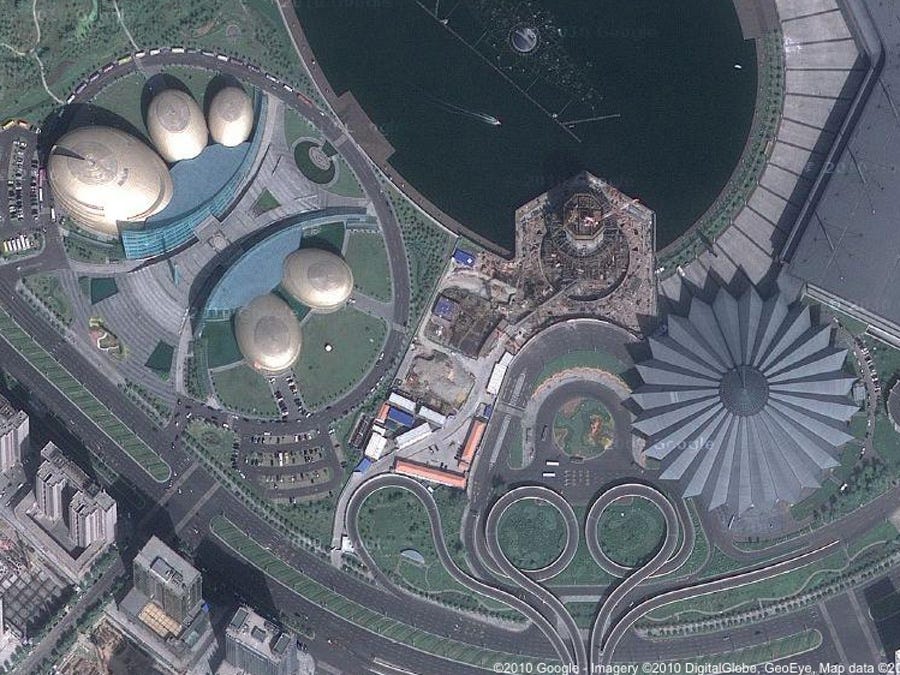
If this is real, it is both amazing and rather depressing.

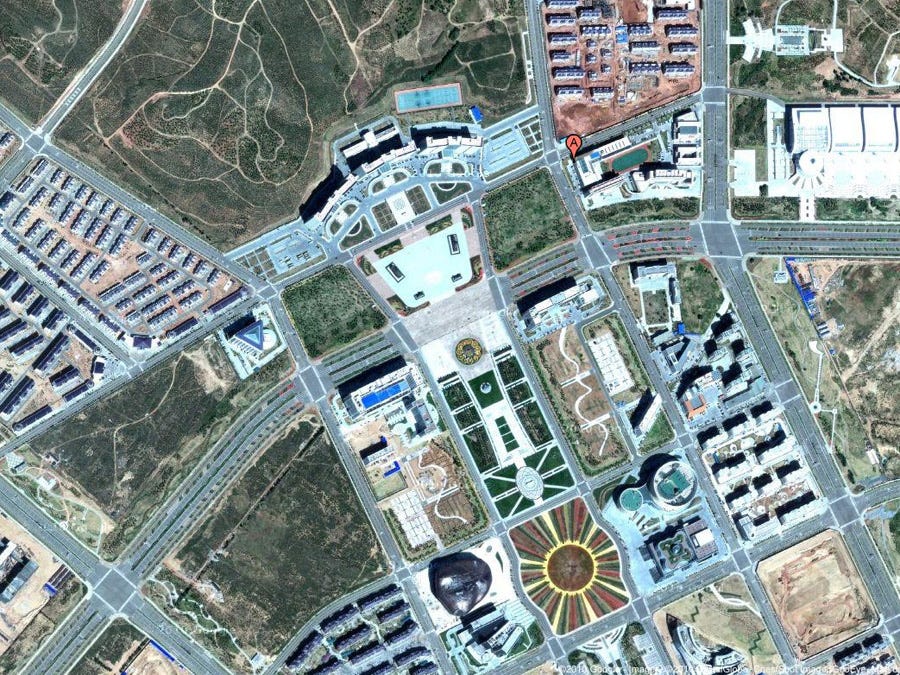
These are satellite images of huge developments in China. Developments in the middle of nowhere, meant to house people that don't live there and parking lots for businesses that don't exit.
How do you know there is no economic activity? No cars, empty roads, no trucks bringing goods to stores, no smoke from the factories, no trash in the streets, no children in the schools.
We saw this kind of thing in Soviet Russia, where towns were built not because of economic necessity, but because of central planning. The result was that after the fall of the Soviet Union, these towns were abandoned as people left to pursue a life elsewhere. Will the same fate fall on China or are they just setting the stage for massive future growth?
Time will tell, but the market will direct economic activity better than any city planner or government bureaucrat.
Thursday, December 9, 2010
Panama Canal Reopens
From CNN:
The Panama Canal reopened Thursday after heavy rains and flooding prompted its closing for only the third time in its storied 96-year history.
Officials closed the canal around noon Wednesday after heavy rain in the Chagres River area, caused water behind the Gatun Dam -- which creates Lake Gatun, a significant part of the canal -- to rise.
The canal was reopened 17 hours later.
The last time the canal closed was in 1989, after the United States invaded Panama to topple strongman Manuel Noriega.Landslides forced the canal to close for several months from late 1915 to mid-1916, just months after it opened.
The 48-mile canal is a key conduit for shipping between the Pacific and Atlantic oceans. The canal was built from 1904 to 1914 by the United States, which had sole control over the channel across the Panamanian isthmus until 1979. Then, after 20 years of joint U.S.-Panama control, the Panamanian government assumed administration on December 31, 1999.
3 times in only 96 years? What a hard working canal! These heavy rains would be very infrequent, only once in a hundred years or so. But you have to wonder if they would become more common in the future.
Subscribe to:
Posts (Atom)


